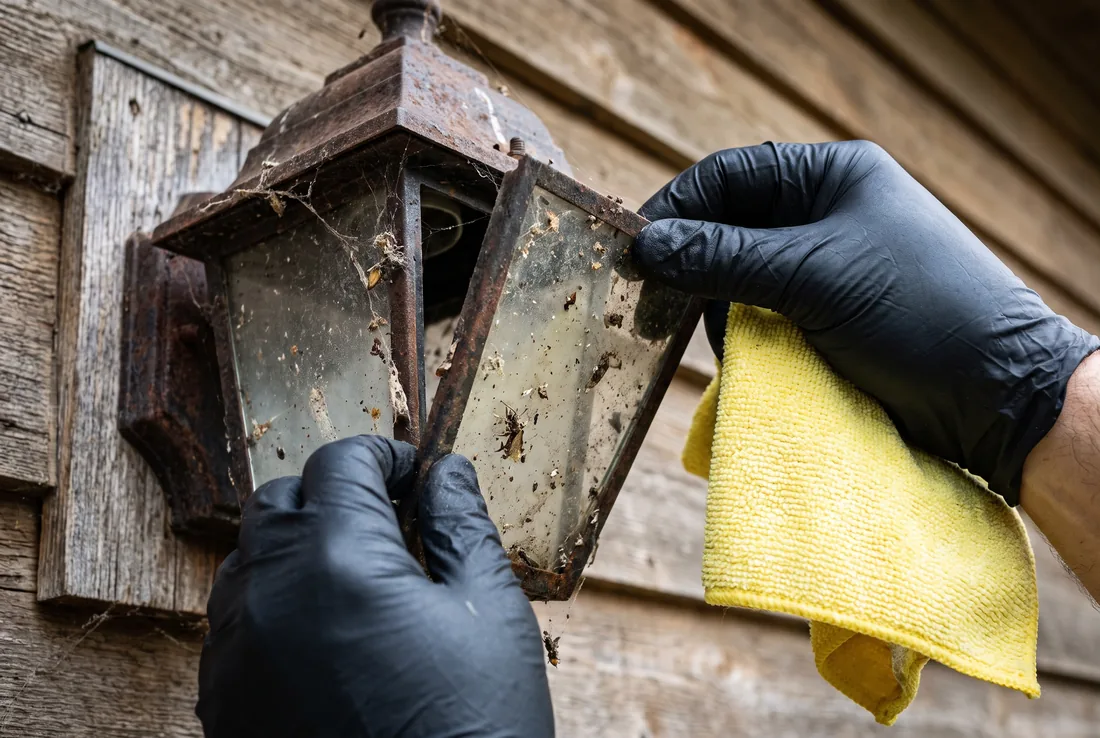
Why fixtures take more than windows
A landscape light is often within a few feet of a sprinkler head and directly in its arc, so it gets soaked every cycle rather than occasionally clipped the way an upper window might be. Local water runs moderately hard, and a lot of irrigation here draws on canal water carrying fine silt on top of the dissolved minerals. Multiply either source across a full irrigation season running several times a week and the lens accumulates deposit far faster than a window two stories up ever could.
Why it crusts instead of rinsing off
Hard water carries dissolved calcium and magnesium. As each cycle's water evaporates off the warm lens, those minerals fall out of solution and are left behind as a solid deposit, and that deposit bonds to the glass or plastic surface chemically rather than sitting loosely on it. That is why a second rinse from the next irrigation cycle does not wash it away; it just adds another thin layer on top of the last one, and the crust builds in visible rings the way scale builds inside a kettle.
It is not only cosmetic
Mineral crust on a lens blocks light output, so fixtures get visibly dimmer over a couple of seasons and people replace bulbs that were never actually the problem. Worse, mineral deposit and the moisture that keeps depositing it sit directly against the fitting's contacts and seals, and that combination corrodes them over time. That is how a fixture goes from dim to intermittent to dead, and once that internal corrosion has set in, no amount of cleaning the lens reverses it.
Coated and painted fixtures need care, and old crust may have already etched the lens
Many fixtures have a powder-coated or painted housing, and aggressive acidic descalers strip or discolor it, which is a common way a cleaning attempt turns into a replacement. Testing any descaling product on a hidden part of the housing first, rather than the whole fixture, avoids that. Separately, on a lens that has carried heavy crust for several seasons, the same mineral deposit that etches shower glass over time can etch a thin fixture lens even faster, since it is smaller, thinner, and often lower quality glass or plastic to begin with. Once that surface is genuinely etched rather than crusted, cleaning improves it but does not return it to new.
Aim the sprinkler, then clean the fixture
As with windows, the durable half of the fix is moving the head or the fixture so they are not in the same arc. A fixture cleaned and left in a sprinkler path is crusted again within a season, and unlike a window it is also quietly corroding while it sits there, which makes re-aiming worth doing before the next cleaning rather than after.
Want This Done For You?
Free, no-obligation quote — we'll call or text you with your price.
Get My Free Quote