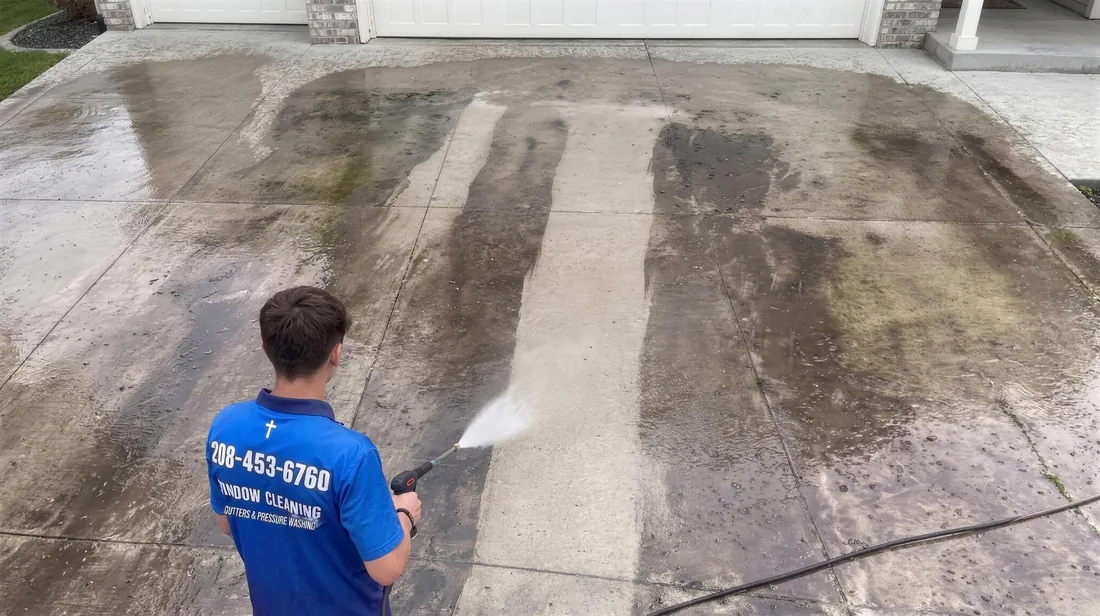
Where valley rust stains come from
Three sources cover almost all of it. Irrigation water drawn from a private well, more common on outlying and rural-adjacent lots, carries dissolved iron and deposits it wherever a sprinkler wets concrete repeatedly. Fertilizer containing iron gets flung onto a driveway by a spreader and stains within hours of getting wet. And metal objects such as furniture feet, tools or planters left on damp concrete leave their own footprint as the metal itself oxidizes against the surface.
Why pressure alone does not work
Pressure removes what is sitting on the surface. An absorbed chemical stain is below it, soaked into the pore structure of the cured concrete. You can strip the top layer with enough force and still see orange underneath, and if you push hard enough to make visible progress you will etch the surface and leave a permanently lighter patch that is more obvious than the stain was. That trade is not worth making.
What actually removes it: chelation, not scrubbing
Rust needs a chemical treatment, typically built around oxalic acid or a similar chelating agent, that binds to the iron ions in the stain and converts them into a soluble compound that can then be rinsed out of the pore structure rather than scrubbed off of it. That is a fundamentally different mechanism from washing: nothing is being scoured away, the iron itself is being chemically converted so plain water can carry it out. It is applied with dwell time and then flushed, which is why rust removal is quoted separately from a standard driveway clean rather than assumed to be part of it.
Why this is worth hiring out on anything beyond a small spot
Chelating acids strong enough to work on set-in rust are also strong enough to irritate skin and eyes, and applying them unevenly across a large driveway produces a blotchy, partially treated result rather than a uniform one. A small spot from a single planter is a reasonable DIY job with a consumer rust remover and basic care. A driveway-wide stain from years of sprinkler contact is worth professional application, both for even coverage and for keeping concentration and dwell time in the range that removes rust without etching the surface underneath it.
Stop the source or it returns
If the well-fed sprinkler still wets that spot every morning, the stain rebuilds regardless of how well it was removed. Re-aiming the head or fitting an iron filter on the irrigation line is the durable half of the fix, and removing the stain without doing it means paying to do the same treatment again next season.
Want This Done For You?
Free, no-obligation quote — we'll call or text you with your price.
Get My Free Quote