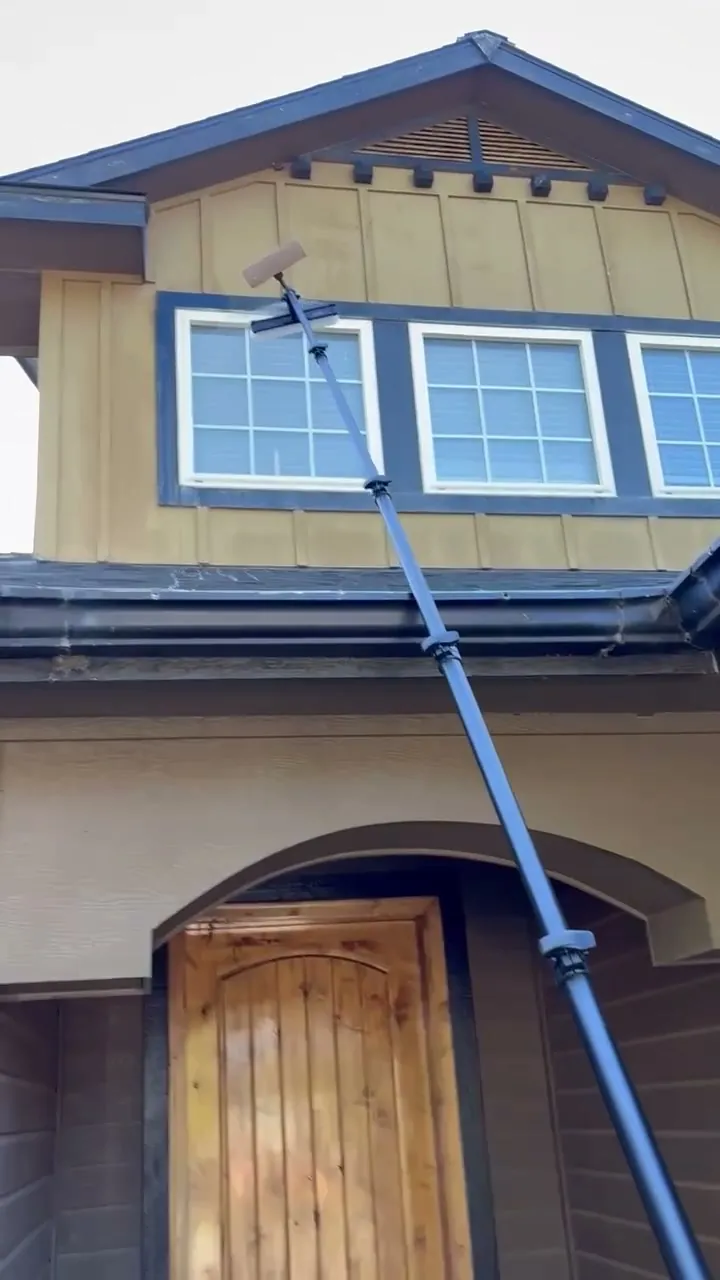
The actual risk is the ladder, not the height
Falls from height are the most common serious injury in this trade and among homeowners attempting it themselves. The dangerous moments are setting up on uneven ground, over-reaching sideways rather than climbing down to reposition, and the last step of the climb, when fatigue and a sense of being almost done both work against caution. None of those are about skill with a squeegee, and all of them are worse on the sloped, soft or gravel ground common around valley homes.
What a water-fed pole reaches, and why it dries without streaking
Professional pure-water poles clean from the ground to roughly three stories, which covers essentially all residential work in the valley. The glass is scrubbed with a brush and rinsed with deionized water, which has nothing dissolved in it to leave behind. Ordinary tap water leaves faint mineral spots as it evaporates, which is why a hose rinse alone never looks quite finished. Deionized water evaporates and leaves nothing, so the glass air-dries genuinely spot-free without anyone touching it with a cloth. That removes both the ladder and the streaking from the job at once.
Where poles stop working
Poles need a clear line to the glass. Deep recesses, glass behind mature landscaping, enclosed courtyards, and windows above a conservatory or lower roof often cannot be reached from the ground at the right angle. Those need ladder work by someone insured to do it, or occasionally specialized equipment, and it is fair to ask how a company plans to reach a specific window before they show up.
Poles only reach the outside
A water-fed pole cleans exterior glass from the ground. It does nothing for the interior side of a second-story window, which still needs someone physically inside the house at that window, whether that means a stable step stool for a low sill or genuine ladder or lift access for a tall stairwell or great-room window. Anyone quoting a whole-house clean that includes interior second-story glass should be accounting for that access separately from the pole work outside.
The insurance point that actually matters
If an uninsured person is hurt on your property, that can become your problem. Confirming a company carries genuine liability coverage is not paperwork theater for work at height, and it is a reasonable thing to ask before anyone puts a ladder against your house.
Want This Done For You?
Free, no-obligation quote — we'll call or text you with your price.
Get My Free Quote